If you manage a commercial playground in Florida whether for a beachside resort, an HOA community near the Intracoastal, or a public school within a few miles of the coastline you face a constant, unseen adversary: coastal salt air.
Florida boasts over 1,350 miles of coastline, meaning a vast majority of the state’s commercial properties operate within what corrosion engineers call a marine atmospheric zone. While sunny skies and ocean breezes draw millions of visitors and residents to the Sunshine State, that same salt laden air creates a hyper corrosive environment that can quietly destroy commercial playground hardware from the inside out.
Unchecked metal oxidation does more than spoil the appearance of your play equipment. It degrades structural load capacities, causes moving components to freeze or snap, and creates severe safety hazards that lead to failed safety audits and denied insurance claims.
This comprehensive guide breaks down the science of coastal salt corrosion, where it hides on commercial play structures, how inspectors evaluate rust hazards, and the exact steps you can take to stop rust before it compromises your playground.
The Science of Coastal Corrosion: Why Florida Is Unique
To understand why playground hardware deteriorates so rapidly near Florida’s coasts, it helps to look at the chemistry of marine atmospheres.
- Airborne Salt Deposits: Ocean waves release microscopic saltwater droplets into the atmosphere. As the water evaporates, tiny sodium chloride ($\text{NaCl}$) crystals remain suspended in the air, drifting anywhere from 1 to 20 miles inland depending on wind patterns.
- The Electrolyte Effect: Iron and steel naturally want to return to their raw state (iron oxide/rust) when exposed to oxygen and water. Salt acts as a powerful catalyst. When airborne salt settles on metal hardware, it dissolves into the thin moisture film formed by Florida’s high humidity, creating a highly conductive electrolyte solution that accelerates electrochemical oxidation.
- Thermal Acceleration: Chemical reactions double in speed for roughly every 10°C (18°F) increase in temperature. Florida’s year round warmth means the chemical reaction that forms rust runs continuously at top speed, degrading metal up to 5 to 10 times faster than in drier, cooler inland states.
The Top 5 Corrosion Hotspots on Commercial Play Equipment
Rust rarely starts in plain sight. On a commercial play structure, salt air attacks specialized connection points and load bearing components where moisture and debris collect.
1. Main Support Post Bases
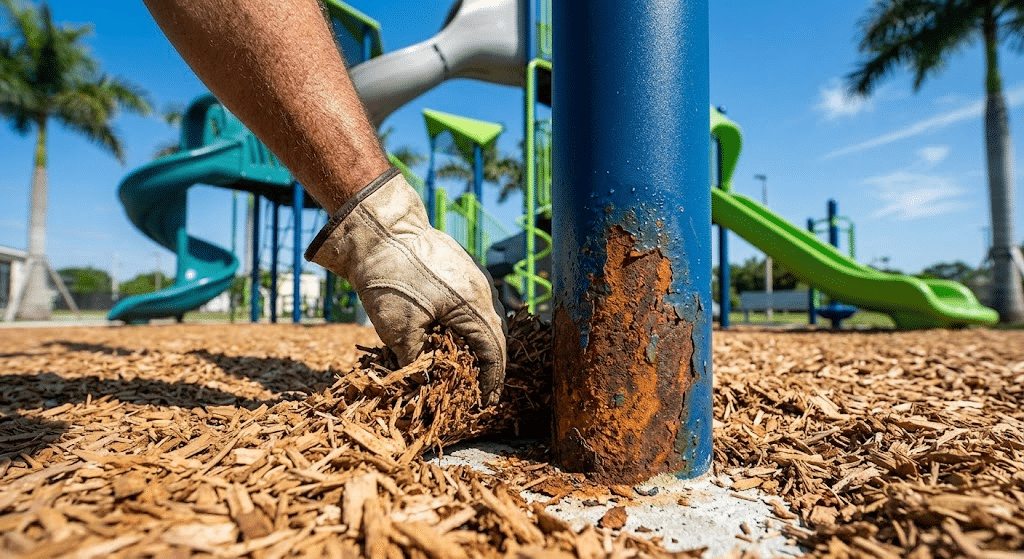
The base of an upright steel post right where it meets the ground or protective surfacing is the single most dangerous corrosion zone. Damp Engineered Wood Fiber (EWF) or porous rubber surfacing traps moisture against the post base. Learn how to manage surfacing wear and moisture traps in our Central Florida summer playground upkeep checklist. Corrosion frequently eats through the steel column beneath the surfacing level, hiding structural weakness from casual visual checks.
2. Swing Assemblies, S Hooks, and Shackles
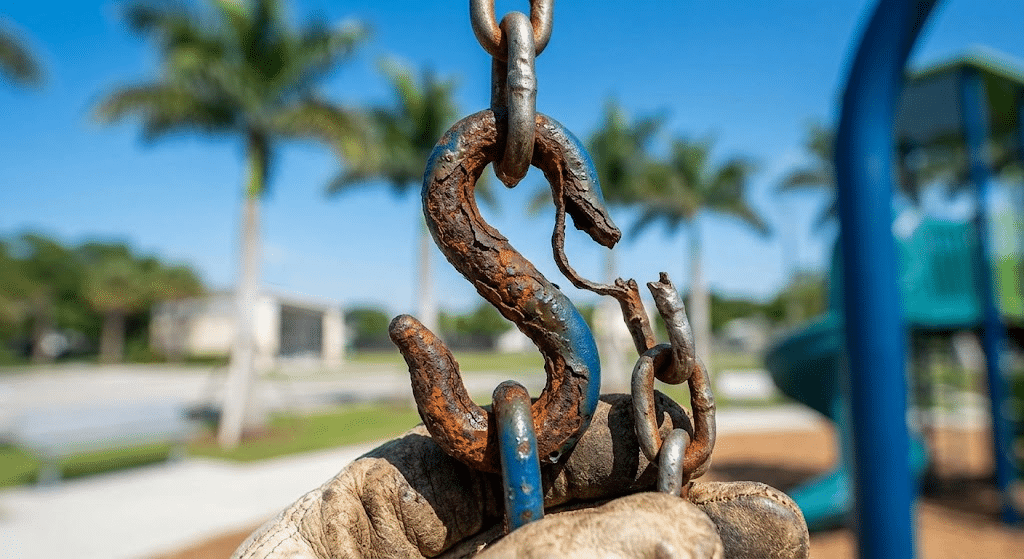
Swing hangers, S hooks, and chain links experience constant mechanical friction as children swing. This movement strips away protective zinc galvanizing or powder coating, exposing bare steel to salt air. As chain links rub against each other, corrosion thins the metal, dramatically reducing weight bearing limits.
3. Deck Welds and Clamp Enclosures
Where horizontal deck frames are welded to vertical support posts, metal experiences high structural stress. Small hairline cracks in the factory powder coating allow salt water to creep under the paint layer a process called filiform corrosion. The rust spreads beneath the surface like a spiderweb, lifting the paint and weakening the joint weld.
4. Fasteners, Bolts, and Hardware
Standard steel bolts, lock washers, and rivets expand as they rust (iron oxide occupies up to 6 times the volume of the original steel). This expansion known as rust packing places intense outward pressure on surrounding plastic panels, deck clamps, and composite materials, causing them to crack and split.
5. Internal Frame Columns
Water frequently enters steel support posts through unsealed top caps, open bolt holes, or damaged roof mounts. Because the interior of a pipe lacks powder coating, water collects at the bottom cap and rusts the post from the inside out, leaving a hollow shell that can buckle without warning.
How CPSI Inspectors Evaluate Corrosion Hazards
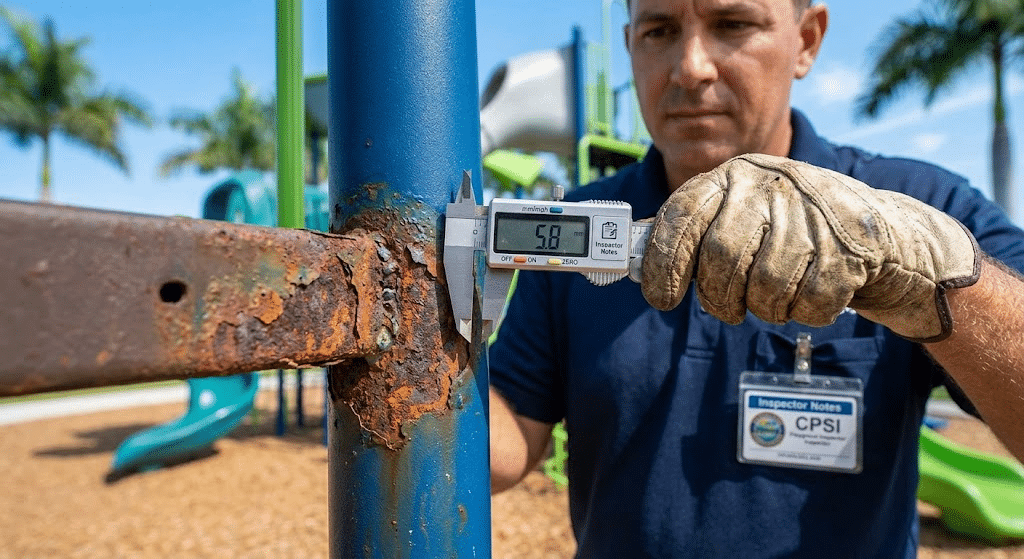
During a formal audit by a Certified Playground Safety Inspector (CPSI), rusted equipment is evaluated against official playground safety standards and CPSC hazard benchmarks. Inspectors classify rust using three primary risk levels
- Priority 3 (Minor Defect): Surface rust that has chipped paint but has not thinned the underlying metal. This requires routine cleaning, priming, and painting.
- Priority 2 (Serious Hazard): Rust that has worn down chain links or shackles by up to 50% of their original thickness, or structural rust creating minor sharp edges. Immediate hardware replacement is required within 14 to 30 days.
- Priority 1 (Imminent Hazard): Severe internal or structural rust where a main support column, swing beam, or platform weld has lost structural integrity or can collapse under load. The affected equipment must be shut down and locked out immediately.
The Action Plan: How to Stop Salt Air Corrosion
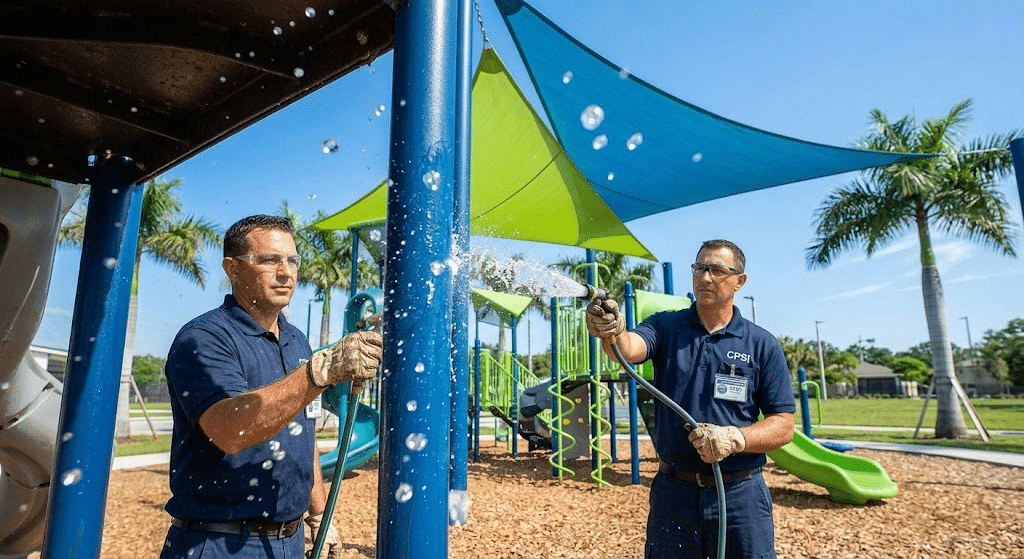
If your playground is located within 20 miles of the coast, standard maintenance routines are not enough. You need an active, multi layered rust prevention strategy designed for marine environments.
1. Upgrade Material Specifications on New Procurements
If you are ordering new equipment or replacement parts, specify marine grade materials built to withstand coastal environments:
- 316 Stainless Steel Hardware: Always specify 316 grade stainless steel for bolts, S hooks, shackles, and chain assemblies instead of standard zinc plated or 304 grade steel.
- Aluminum vs. Steel Posts: For coastal properties, high strength aluminum support posts will never rust like steel, making them ideal for coastal resorts and HOAs.
- Heavy Duty Vinyl Coatings: Ensure decks and steps feature thick, PVC/vinyl dip coatings rather than basic paint, sealing metal completely against moisture.
2. Implement a Fresh Water Rinse Routine
The simplest, most cost effective way to stop rust on coastal playgrounds is to wash away accumulated salt crystals.
- Establish a bi weekly or monthly schedule to spray down all metal hardware, posts, and swing connectors with clean, pressure regulated fresh water.
- Rinsing removes dry salt deposits before humidity transforms them into corrosive liquid electrolytes.
3. Perform Monthly Hardware Audits & Surface Seals
- Inspect post bases at the surfacing line by scraping back loose fill wood fiber or checking rubber seams for hidden rust.
- Immediately repair chipped powder coating using marine grade zinc rich primers followed by UV resistant outdoor enamel touch up paint.
- Apply spray on fluid corrosion inhibitors or marine lanolin wax to hidden bolt threads, internal clamp joints, and open swing shackles quarterly.
4. Replace Worn Hardware Before It Fails
Never attempt to weld severely rusted structural steel or reuse thinned chain links. When hardware exhibits material loss exceeding 15% to 20% of its original thickness, replace the components with OEM stainless steel parts. If structural welds or posts show advanced decay, professional playground repair services are required to replace compromised frames safely.
Summary Inspection Checklist for Coastal Facilities
- [ ] Schedule fresh water spray downs monthly to wash away salt deposits.
- [ ] Inspect post bases below the surfacing line for hidden corrosion.
- [ ] Check swing chains, S hooks, and shackles for mechanical wear and thinning.
- [ ] Touch up chipped paint and exposed metal with zinc rich marine primers.
- [ ] Replace standard galvanized hardware with 316 stainless steel.
- [ ] Keep a written log of all rust inspections, repairs, and hardware replacements.